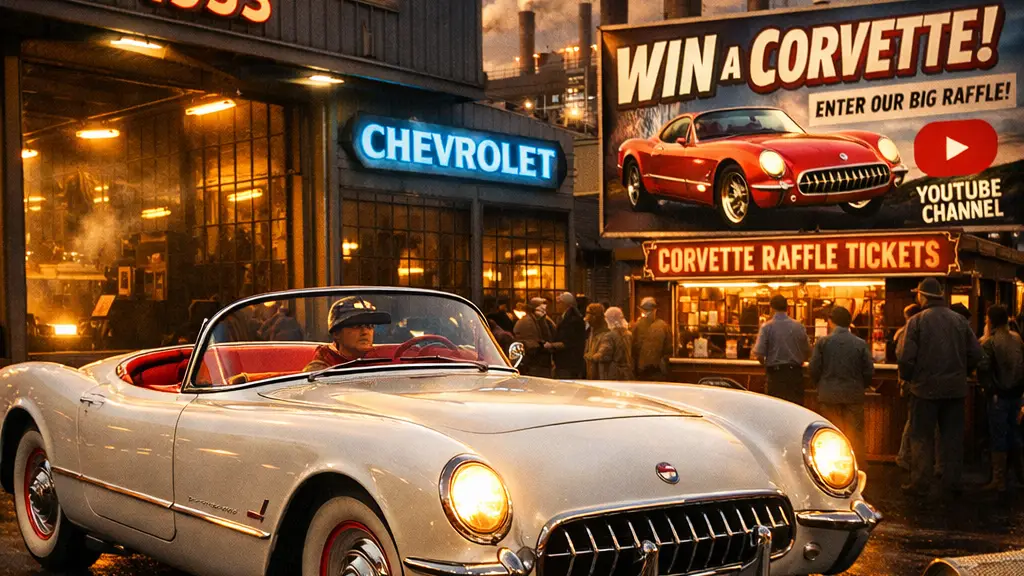
The Chevrolet Corvette rolled out of Flint, Michigan in 1953 and has never stopped— eight generations, no domestic rivals left standing, the only sports car still continuously produced on American soil. It nearly didn't happen. Chevrolet was bleeding market share, and brand manager Thomas Keating saw a sports car as the only remedy. Developed as Project Opel, it was America's answer to the lean British roadsters of the postwar years: fiberglass over a 3.9-liter straight-six, two-speed automatic. It debuted at GM's 1953 Motorama show in the Waldorf-Astoria to an immediately won-over crowd and made it to production—though the 300 hand-assembled units that followed found almost no buyers, a quiet, uncertain beginning for what would become America's sports car.
Chevrolet fully transforms the Corvette for the 1956 model year. The revised front end borrows the long, tapered snout of the Mercedes-Benz 300SL coupe, while scalloped side coves carved into the bodywork give the car a waist and a silhouette that feels almost alive. The V-8 carries over but breathes through a new camshaft that wrings 210 horsepower from the standard Carter four-barrel carburetor—bolt on a second carb and that figure climbs to 225. Small luxuries arrive too: external door handles you can actually grip, windows that disappear cleanly into the door panel rather than the removable curtains of the 1953–1955 cars, and a power-operated folding roof that tucks itself away at the touch of a button.
Slide into an early prototype and the stick-shift 225-hp convertible lunges to 60 mph in 7.5 seconds, nearly four full seconds quicker than the old six-cylinder car that wheezed to the same mark in over eleven. Then 1957 arrives and raises the stakes further: the V-8 grows to 4.6 liters and 283 cubic inches, and an optional fuel-injection system—exotic technology for a production car of the era—pushes output to a then-staggering 283 horsepower, one horsepower for every cubic inch.